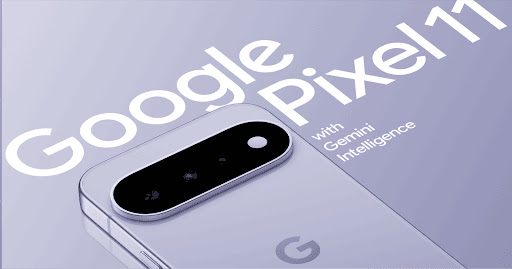
Pixel's everyday phone, with a longer camera reach
Pixel 11 is Google's current mainstream phone for readers who want Google services, a relatively compact display and several camera perspectives in one device. Its documented 5x optical telephoto and magnetic wireless charging provide concrete reasons to consider it. Those features are more useful buying criteria than assuming the newest Tensor chip must win every performance comparison.
Research checked on 4 October 2026 uses Google's US specification page. DelaTechHQ has not physically tested Pixel 11. This review assesses published capabilities; it does not rate actual image processing, screen calibration, call reception or endurance. Country-specific SIM and network details must be checked separately.
Key specifications
- Display: 6.3-inch Actua OLED, 1080 × 2424, with a published 60–120Hz refresh range.
- Platform: Google Tensor G6 and Titan M3 security coprocessor.
- Memory: 12GB RAM; the US page lists 256GB and 512GB storage choices.
- Cameras: 48MP wide, 13MP ultrawide and 10.8MP telephoto; the telephoto has 5x optical zoom.
- Battery: 4,985mAh typical capacity; Pixelsnap wireless charging is listed as Qi2.2-certified, up to 25W.
- Connections: USB-C 3.2, Wi-Fi 6E and Bluetooth 6; the US page describes dual eSIM.
See the Google specification page for configuration footnotes. Storage capacity is not the same as free space after software and personal files.
Build and handling
Google documents glass front and back, an aluminum frame and IP68 dust and water resistance. That rating is not a guarantee against damage in all conditions. A case and suitable care remain practical considerations, especially for someone who keeps a phone for years.
The 6.3-inch diagonal keeps Pixel in the same broad screen-size class as Galaxy S26. It does not mean their shape, weight distribution or grip is identical. A comfortable typing experience depends on the keyboard and your hands, so a short in-store comparison can be more informative than choosing by diagonal alone.
Display and platform
The published refresh range supports a flexible scrolling experience, but we have not assessed motion clarity or brightness outdoors. Peak brightness claims should not be read as a sustained whole-screen measurement. Readers comparing phones for outdoor navigation should seek evidence for that specific scenario.
Tensor G6 identifies the computing platform; it is not evidence of a particular frame rate or export time. Google's camera and assistant features may be more relevant to everyday use than raw chip specifications. The product page lists Gemini tools and image-editing functions, but features can have account, region and connectivity conditions. Buying a phone also does not guarantee permanent access to every paid AI service.
Cameras and real decisions
The 5x optical telephoto is the clearest hardware distinction from Galaxy S26's 3x option. It gives a tighter native framing choice for distant details. For portraits in a small room, however, extra reach may be less useful than the distance you can physically stand from the subject.
Do not equate Google's additional digital or optical-quality zoom labels with additional physical lenses. Likewise, a camera feature list cannot tell us which phone preserves moving faces better indoors. Our comparison therefore separates focal-length choice from image-quality claims and leaves the latter unranked.
Charging, connections and ownership
Pixelsnap provides a documented magnetic wireless charging option. The charging accessory and power source must support the relevant mode; a magnetic attachment alone does not guarantee the stated wattage. Google's 30-plus-hour battery statement is a manufacturer estimate, not DelaTechHQ's result. Brightness, network use and camera workloads can change the outcome.
The US page's dual-eSIM configuration matters if your carrier or travel plans depend on a physical SIM. Check the actual regional device before ordering. Google also publishes seven years of OS, security and Pixel Drop updates. That makes software support part of the ownership case, although repair cost and battery condition still matter over that period.
Verdict and alternatives
4/5: a strong research-based choice for a Google-oriented user seeking magnetic charging, a dedicated long telephoto and an extended software-support commitment. Regional eSIM suitability and the need for compatible charging equipment are meaningful purchase checks. This score does not certify camera quality, AI accuracy or battery endurance, and those unknowns do not support an exceptional 5/5 rating.
Consider Galaxy S26 if Samsung's software, its documented dimensions or a 3x telephoto better fits your routine. Start with the Galaxy S26 review and pair comparison. The Pixel product record collects specifications, while Phones covers the wider category. For a separate decision about paid AI, see Claude versus Gemini. All manufacturer links are informational and contain no invented affiliate tracking.
Pros
- Dedicated 5x optical telephoto
- Documented magnetic wireless charging
- Published seven-year OS/security/Pixel Drop support
Cons
- US dual-eSIM configuration may not suit every carrier
- Charging performance depends on compatible accessories
- AI features have account and regional conditions
Verdict
4/5 for a Google-oriented everyday user: long telephoto and magnetic charging are useful, subject to carrier and accessory compatibility.
Alternatives
Consider these competing routes before buying if you need a different platform, budget, or feature set.
Price Comparison
No active retailer offers are available yet.
View Product DetailsWas this assessment helpful to your buying decision?
We aim to make every review clear, evidence-based, and useful. If you have a question or spot something we should improve, you can contact our editors below.